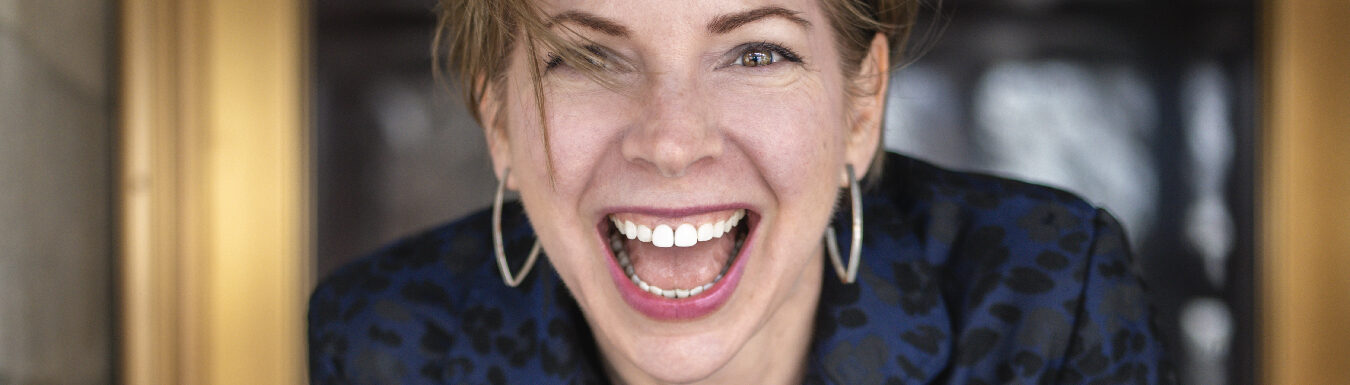
Happy birthday to the woman whose example shaped everything I’ve become.
Some daughters inherit their mother’s recipes. Some inherit her jewelry, or her handwriting, or her way of moving through a room. What I inherited from my mom is harder to name — and more useful: her ambition, her instinct for community, and her belief that you can keep becoming. My earliest memories of her involve pear trees and matching Christmas dresses and Girl Scout camping trips. My most formative ones involve registration tables, membership drives, and a Shirley Temple in hand at the Business After Hours mixer. Both are true. The second is the one that made me.
She did the motherly things. When we were young, she stayed home, kept us fed and clean and loved. Cooking wasn’t really her passion, but she did it well enough that I still use her approach to lasagna, and I’ve never needed another scrambled egg recipe. What she genuinely loved was baking — which was fortunate, because we had a pear tree in the backyard that produced bushels of gorgeous Bartlett pears every fall. So every fall, we spent hours peeling and coring, making what I can only describe as a Forrest Gump inventory of pear products: pear bread, pear preserves, pear pie, pear butter, pear everything. She sewed matching Christmas dresses for my sister and me, made a Halloween costume or two, led our Girl Scout troop on hikes and camping trips and one fateful field trip to the animal shelter — which is how we ended up with Sunny, the family’s first cat.
(My dad was resistant. My mom was persuasive. My dad eventually came to love Sunny completely, because my mom’s instincts, as usual, were right.)
My parents also had the wisdom to make their relationship a priority — occasionally taking overnight trips together, just the two of them. To some that might sound like deprivation; to me it felt like security. They came back refreshed, happier to see us. My sister and I once baked them a welcome-home cake — she made the real one, and I contributed a small round cake from my Easy Bake Oven. We assembled and frosted them together. It looked like this:
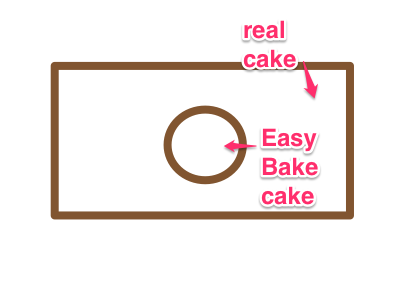
I was enormously proud of my contribution. (My sister, it should be noted, was already becoming a wonderful mother long before she actually became one — but that’s her story to tell.)
Then came the reinvention. I was around seven or eight when my mom went back to work. She started with part-time administrative roles, but she had a gift for this — for organizations, for people, for the architecture of community — and she rose quickly. By the time I was nine or so, she was president and CEO of a chamber of commerce serving five communities, and I had become her most enthusiastic junior employee.
If Malcolm Gladwell is right that mastery takes 10,000 hours, I was clocking mine early. I helped with membership mailers, stuffed envelopes, organized events. I worked the registration table at Business After Hours mixers: checking in attendees, taking money, making change, distributing nametags — all with what I’m told was a very professional smile. When my registration duties were complete, I was allowed to mingle with the adults, Shirley Temple in hand, chatting knowledgeably about dry cleaning services, muffler repair, logistics, and — as it happened — the rise of computers and technology. Little did I know.
What my mom gave me in those rooms wasn’t just exposure. It was belonging. A sense that these spaces were mine to inhabit, that I had something to contribute, that the adult world of ideas and commerce wasn’t foreign territory. I’ve spent my career in rooms like those, speaking to executives and boards and global organizations about technology and humanity. The comfort I feel in those rooms has roots I can trace directly back to her. She also introduced me to acting lessons — something that had captured her own interest — and that opened a door I’m still walking through. I acted in school and community productions, studied what it means to hold a room, to communicate with your whole body, to be present rather than performed. Those are the same skills I use now every time I walk onto a keynote stage. And my mom was always a devoted admirer of Carol Burnett, which felt right to me even as a kid: Burnett prizes the authentic comedic moment over posing or posturing. She earns the laugh; she doesn’t manufacture it. That’s a value system as much as a performance style, and I’m glad it was in the air I breathed.
The work she did as chamber CEO, and later as an elected trustee, was also teaching me something I wouldn’t have words for until much later. She was always thinking about who gets left out — asking: how does this affect families on fixed incomes? What about accessibility for our senior residents? She was doing what we now call human-centered design, going into the community, listening to what people actually needed, not just what the data suggested or what seemed efficient on paper. Growing up in Park Forest, one of America’s first planned communities — designed around the idea that the most affordable homes should be closest to the town center, so young families without cars could walk to everything — gave me a foundational understanding that the spaces we build are never neutral. Every design decision is a decision about human experience.
That through-line runs directly into my work today. When I talk about technology that serves humanity rather than extracts from it, when I advocate for AI that amplifies human potential instead of replacing human connection — I’m drawing on something I first understood by watching my mom understand that place is the framework for how we live together. I’ll close with a small story. In 2008, my mom had been at Obama’s election night party in Chicago but left before the call, not expecting it yet. I was watching returns in Nashville and I called her: go back. They’re about to call it. She went back. She was in that room when history was made. And even across the distance, we were sharing in something extraordinary together — as we had, in our way, so many times before.
At 80, she has spent eight decades creating meaning, showing up, and modeling what it looks like to reinvent yourself with intention and grace. The shared framework she gave me wasn’t domestic — it was professional, it was ambitious, it was the belief that you can keep becoming. When I dedicated Pixels and Place to her, I was trying to say something I’ve spent years finding words for. The most important things she taught me weren’t domestic. They were architectural.
She taught me how to build.
I’m still building, Mom. In no small part because of you.
Happy birthday. I love you. 💖